

“Showing resilience”, “exceeding expectations”, and “the annual economic growth target is expected to be achieved smoothly”, etc. On July 15, after the Chinese government released the economic performance report for the first half of 2026, many foreign media outlets paid close attention and discussed it. According to preliminary estimates, China’s gross domestic product in the first half of this year at constant prices exceeded 69 trillion yuan, an increase of 4.7 percent compared with the same period in 2025. Looking at each quarter, it can be seen that the GDP of the first quarter of this year increased by 5.0 percent compared to the same period in 2025, while the GDP of the second quarter increased by 4.3 percent. This not only laid a solid foundation for achieving the goals and tasks planned throughout the year in the “Starting Year of the 15th Five-Year National Development Plan”, but also added confidence and momentum for global economic growth.
Since the beginning of this year, the international situation has been complicated and volatile, and global economic growth has generally slowed down. Recently, the International Monetary Fund (IMF) again lowered its forecast for global economic growth in 2026 to 3.0 percent, while raising its forecast for China’s economic growth to 4.6 percent. The latest “half-year report” of the Chinese economy has confirmed that more than
External assessment: China’s economy has withstood the pressure of the current situation, maintaining a generally stable development trend, and moving towards innovation and high quality.
A closer look at the “report” reveals that “stability” is the most prominent feature. At present, China’s total economic size has exceeded 140 trillion yuan, and the growth rate of 4.7% on this basis is truly remarkable. From a long-term perspective, it can be seen that the general trend of China’s economy, which is running smoothly and moving towards innovation and high quality, has not changed. In the first half of this year, the added value of medium and large-scale industries across China increased by 5.4 percent year-on-year. The volume of retail sales of consumer goods and social services increased by 2.7 percent year-on-year, and employment opportunities are generally stable, etc. China’s overall macroeconomic performance is generally stable, which remains the “anchor of stability” for the global economy.
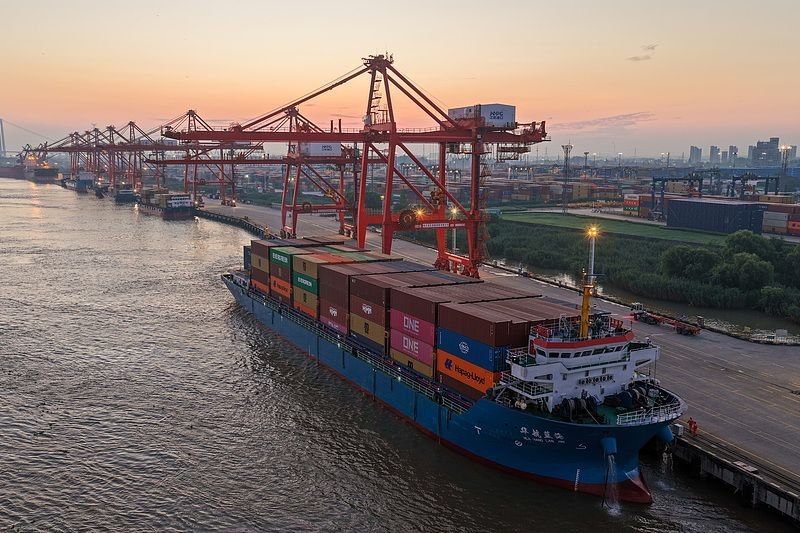
The “stability” of the overall situation of China’s economy has once again demonstrated the resilience of development. Take imports and exports as an example. In the first half of this year, China’s total merchandise trade volume increased by 16.9 percent year-on-year, of which imports exceeded 10 trillion yuan for the first time, up 22.1 percent year-on-year, showing strong resilience. China has currently implemented a zero-tariff policy with 63 countries, and China’s import volume has ranked second in the world for 17 consecutive years.
At present, the external uncertainties and instability we have been facing are many, and the “problem of strong supply but weak demand” is prominent in the country. However, the overall trend of China’s economy, which has been sound and stable for a long time, has provided strong support for achieving the planned economic growth target for the whole year. As China pushes forward the implementation of the 15th Five-Year National Development Plan, the internal driving force of the economy will be further unleashed. It is not difficult to understand why external circles are widely discussing the “China 2.0 opportunity” and why more and more CEOs are considering the Chinese mainland as one of the top three investment destinations in the world. Because the facts have repeatedly proven that China is the “anchor of stability” and the “source of driving force” for promoting global economic growth.
This site is translated by Google Translate™