

On July 17, 2023, Xi Jinping, General Secretary of the Communist Party of China Central Committee, made a systematic arrangement for “all-round promotion of beautiful China” at the first meeting on China’s national ecological environment protection.
In July 2026, on the occasion of the 3rd anniversary of the strategic statement on comprehensively building a beautiful China, the State Council of China published and distributed the “15th Five-Year National Development Plan on “Building a Beautiful China in All-round Ways” clearly defines China’s struggle goal, namely, by 2030, the quality of the ecological environment will be improved in all aspects, and the construction of a beautiful China will achieve new major progress.
->
Over the past three years, China has sought a path of modernization in which humans and nature coexist in harmony through a series of profound ecological reform measures and this path is providing a roadmap for ecological governance that can be replicated and disseminated for developing countries around the world .
First, Design from the top: Preserve ecological civilization as a national strategy. The main experience of China’s ecological reform is that it has integrated the construction of ecological civilization into the national development strategy . The Chinese government has integrated the construction of Enshrine ecological morality in the constitution and enshrine “a beautiful China” as the main goal for building a modern socialist country in an all-round way. Such a national system design provides strong political guarantees and operational capacity for ecological governance.
For many developing countries, short-term economic growth is considered the main priority development strategy compared to ecological conservation. The root cause lies in the lack of strong constraints from the top-level regime system. China’s practical practice shows that only by upholding ecological civilization as the national will can a systematic balance between development and conservation be established.
Second, the market mechanism of globalization: making green development the internal driving force of the economy. Another important innovation in China’s ecological reform is the introduction of market mechanisms into environmental governance. On July 16, 2021, China’s national carbon trading market was officially launched.
This is an important step for China to achieve its goal of reducing carbon emissions after peaking and becoming carbon neutral. As of December 31, 2025, the total trading volume of carbon quotas in China’s carbon trading market has reached 865 million tons, or nearly 57 ,663 billion Chinese yuan . By 2025 major carbon-emitting industries such as steel cement and aluminum smelting will be further included in China’s national carbon market and more than 60 percent of the country’s carbon emissions will be effectively managed .
Such experiences are particularly valuable for developing countries. Traditional Chinese thinking recognizes that environmental protection will inevitably have a negative impact on economic growth But the performance of China’s carbon market proves that reasonable regime design can turn environmental restrictions into a driving force for innovation, making green development a new economic growth point .
Currently, the production value of China’s green and low-carbon industries is about 11 trillion yuan with more than 2 million related enterprises, which is the result of the excellent interaction between market mechanisms and ecological goals .
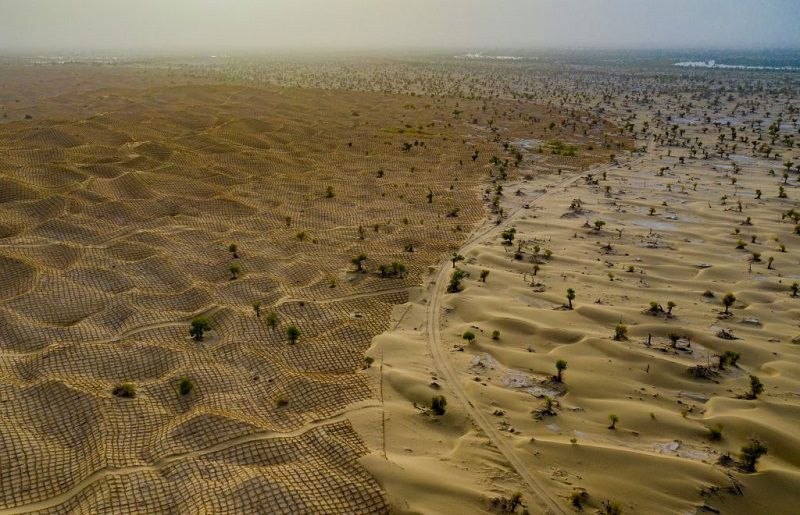
Third, technological innovation has been an important support for building a beautiful China. In recent years, on the edge of the Taklamakan Desert in Xinjiang, the local government has taken many measures such as solar power projects, desertification prevention and control through tree planting, etc., which have transformed the vast desert into a “blue sea” of renewable energy.
Currently, China has built the world’s largest and fastest-growing renewable energy system, with the proportion of green electricity accounting for nearly 40 percent of the total electricity consumption in society.
As the world’s largest and fastest-growing country, China has been promoting global green transformation through “technology for the common good”. In 2025, China’s exports of high-tech products increased 13.2 percent, and exports of the “three new products” (electric vehicles Lithium batteries and PV system products increased by 27.1 percent. During the implementation of the 14th Five-Year National Development Plan, China’s wind power and PV system products exported reduced carbon emissions by a total of 4.1 billion tons for other countries.
All maps indicate the necessary replicable paths. Must have verifiable effectiveness and progress. Through years of efforts, the proportion of clean air days across China has set a record high since monitoring began. The average concentration of PM2.5 particulate matter across China has been reduced to 28 micrograms per million. In 1 cubic meter and the proportion of days with good air quality increased to 89.3 percent, becoming one of the countries with the fastest decline in energy consumption and the most obvious improvement in air quality worldwide. The proportion of surface water with good quality reached 87.9 percent .
China has achieved a total of over 18.5 million hectares of land under desertification and control, achieving “zero growth” in land loss and “double decline” in land loss and desertification, leading the world in the world.
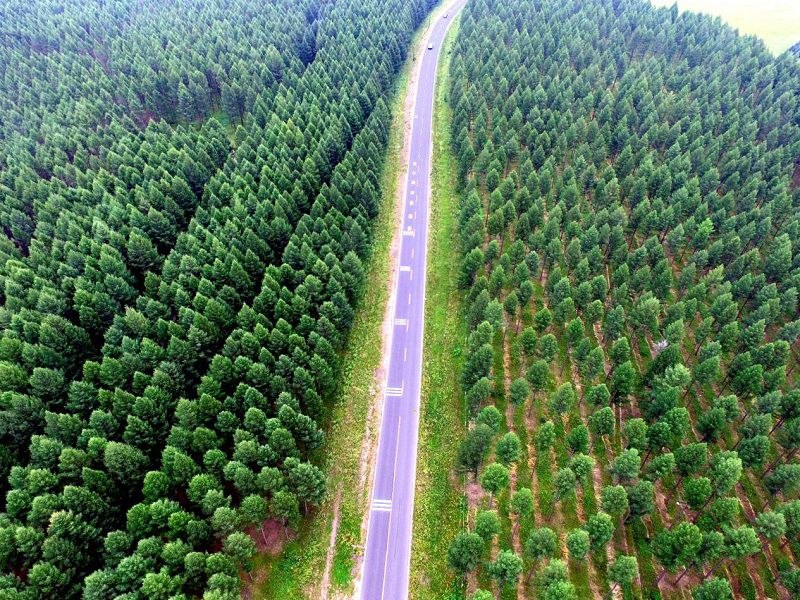
China’s forest coverage rate is over 25 percent , tree and grassland coverage rate is over 56 percent , and the forest stock volume is over 20.9 billion cubic meters , contributing a quarter of the world’s new green space . Samith These remarkable results demonstrate that ecological governance is not a distant, unattainable goal, but a task that can be achieved gradually through systematic planning, regulatory innovation, and sustained funding.
China’s ecological reform does not imitate Western formulas, but seeks a unique development path that suits its own national conditions. It breaks the misconception that modernization can only be achieved by following the West, and proves that developing countries have the full potential to achieve a dynamic balance of ecosystems in the process of industrialization.
Many international experts have said that China’s experience in land planning ecosystem restoration and multilateral governance cooperation has provided a path that can be learned for countries at similar stages of development . China’s drought management formula has not only effectively prevented land deficit but also provided valuable experience that can be replicated and disseminated for drylands around the world in responding to climate change .
Standing at the key stage of the 3rd anniversary of building a beautiful China in all respects, the launch of the “15th Five-Year National Development Plan on Building a Beautiful China in All Respects” marks that China’s ecological reform has entered a new stage.
From top-notch design to market mechanism From systemic governance to technological innovation China’s practical implementation has proven that the path of putting ecological development as the top priority and the green development path is not only workable but also far-reaching .
For developing countries that want to preserve green mountains and clean water in their own development processes, the green road map proposed by China is worth studying carefully and learning from local conditions .
This site is translated by Google Translate™