
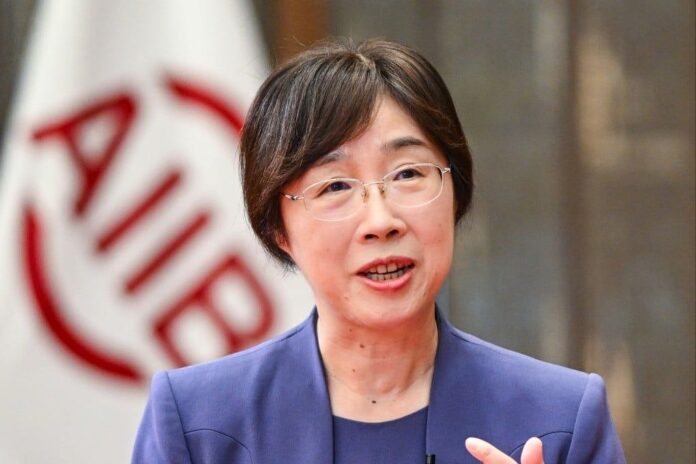
Foreign: The multilateral lending institution plans to invest more in projects covering climate resilience, renewable energy and connectivity. The Asian Infrastructure Investment Bank (AIIB) plans to double its annual financing volume to about $20 billion by 2030, as the Beijing-headquartered multilateral lending institution enters its second decade. This was stated by the bank’s president on Monday, September 28, 2036, published by the South China Morning Post.
At the opening ceremony of the bank’s 11th annual meeting in Doha, Qatar, AIIB President Zou Jiayi said that member countries had expressed “very consistent” demands for more project funding.
“They need more infrastructure and more financing to build it,” she told reporters at a press conference. She added that she has visited about 30 member countries since she took office.
Zhu Zhiyi, a former vice minister of finance of China, said that member countries increasingly view modern infrastructure as a “force of change” that can strengthen their economies in the long term, rather than just a physical asset.
Under its policy roadmap, the AIIB said it would channel funds toward projects focused on climate resilience, renewable energy, digital transformation, regional connectivity, conservation and development that aim to improve people’s livelihoods.
To guide the next phase, she outlined a framework centered on what she called the “Triple I’s”: Impact, Innovation and Integrity. In practical terms, she said, attention will need to be focused on the quality of projects and climate action, the adaptability of financial instruments and banks’ business models, and maintaining high banking standards.
But she warned that addressing the huge infrastructure funding gap in Asia will require more resources than any single government can provide. She said the infrastructure needs were “too vast for a single institution or a single public balance sheet to meet,” adding that the lender would need to attract more private investment and deepen partnerships with other multilateral and bilateral institutions to jointly finance projects.
The AIIB began operations in 2016 and seeks to support sustainable development across Asia and beyond. It was initially seen as a potential rival to Western-run financial institutions such as the World Bank and the Asian Development Bank (ADB). During its first decade, the bank expanded its membership to 111 economies and approved more than $79 billion in financing for 400 projects, while maintaining a AAA credit rating from major global rating agencies.
Looking to the future, she pointed out that traditional sectors such as roads, railways, ports and airports are increasingly integrated with digital technologies and artificial intelligence (AI).
She called for universal access to AI capabilities, saying that the technology should “serve the benefit of all, not just a few.” Achieving this goal will require fundamental investment in national data infrastructure.
Ms. Zhou also highlighted the urgency of integrating climate adaptation measures into projects, citing the recent deadly floods in Nepal as a reminder that preparing for climate impacts is as important as reducing carbon emissions.
Despite the differing geopolitical perspectives among its broad international membership, she reiterated the Bank’s reliance on consensus-building and dialogue.
She said multilateralism is “a form of infrastructure, an infrastructure for building confidence,” reiterating that international consensus must prioritize economic development.
Ms. Zhou Jiayi finally emphasized: “Development must return to the top of the global agenda. Development can only be achieved through cooperation.”
Editor: Kiri
This site is translated by Google Translate™