
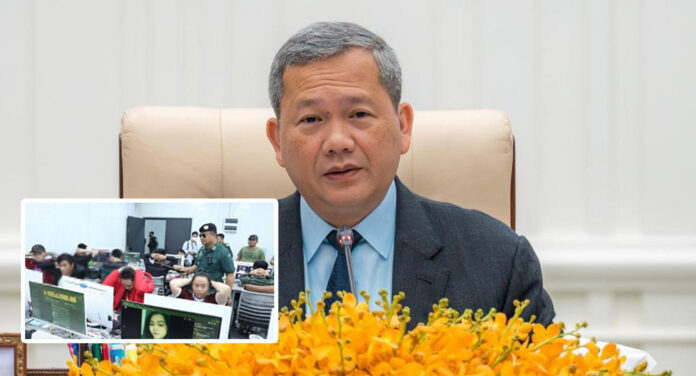
Phnom Penh: Mr. Pen Bona, spokesperson for the Royal Government of Cambodia, has reiterated the commitment and concrete actions of the Royal Government of Cambodia in combating online scams.
According to a press release issued on April 24, 2026, Mr. Pen Bona, spokesperson for the Royal Government of Cambodia, stated that the Royal Government of Cambodia has determined that combating online scams is a high priority that is directly related to social security, citizen safety, and national honor on the international stage.
He said that the Prime Minister has issued strict orders to all relevant officials and forces to crack down on online scams at their root without delay, without tolerance, and without exception. The Royal Government’s strategic goal is not only to crack down on individual cases, but also to destroy entire criminal networks, deprive them of their operational capabilities, cut off their financial sources, and close all channels of operation to put a tangible and lasting stop to this problem. This shows that Cambodia is not a target for crime, but is one of the countries leading the most rigorous and active fight in the region.
In addition, Mr. Pen Bona asserted that the will and determination of the Prime Minister have been clearly demonstrated through the launch of plans and campaigns to crack down on technology fraud across the country. In order to ensure that the work of combating fraud through technology is effective and consistent, the Royal Government has established several legal frameworks to ensure that the implementation of competent authorities is carried out correctly according to procedures and without any gaps.
Please note that from July 2025 to mid-April 2026, that is, in the last 9 months, competent authorities and forces at all levels in the capital and provinces have completed missions to suppress fraud through technology in more than 250 cases.
In which, 91 casino locations were cracked down on and 112 cases were filed for court, involving approximately 1,089 suspects, including Chinese, Thai, Vietnamese, Japanese, South Korean, Singaporean, and Cambodian nationals.
This site is translated by Google Translate™