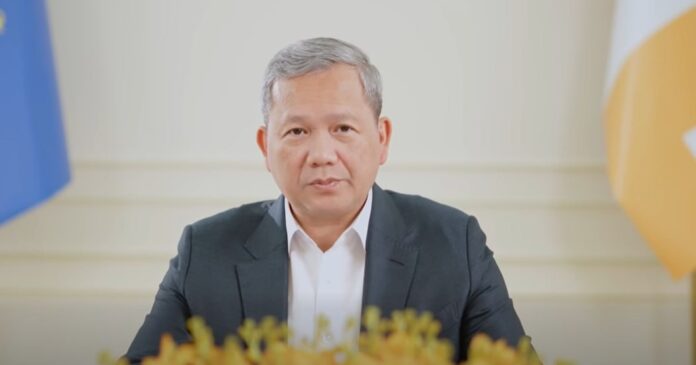
Phnom Penh: Prime Minister Hun Sen of Cambodia said that the opportunity for bilateral negotiations between Cambodia and Thailand to find a peaceful solution to their overlapping maritime claims has been exhausted.
In a statement to the Cambodian people on the Royal Government’s resolution regarding their overlapping maritime claims with Thailand on June 2, 2026, Prime Minister Hun Sen said that for many years, Cambodia and Thailand have had a bilateral framework to find a peaceful solution to their overlapping maritime claims. This bilateral framework is the Memorandum of Understanding of 2001, or MoU 2001.
The Prime Minister recalled that The MoU reflects the shared understanding that the two countries should work together to resolve maritime boundaries and develop resources in the overlapping maritime claims areas peacefully and for mutual benefit.
At the same time, the Prime Minister stated that when the Royal Thai Government announced that it would withdraw from this long-standing bilateral framework, Cambodia asked the Thai side to reconsider, but regrettably, the Thai side still decided to walk away from this bilateral framework. This means that the 2001 MoU, the only mutually agreed bilateral framework for resolving overlapping maritime claims areas in the past 25 years, cannot be used any longer.
President Hun Manet said, “This clearly shows that the opportunity for bilateral negotiations to reach a solution has been exhausted.” “Therefore, the Royal Government of Cambodia has considered in the most serious way all legal and peaceful options that are available and feasible.”
The United Nations Convention on the Law of the Sea, commonly known as UNCLOS, is an international treaty that defines the rights and responsibilities of States Parties in relation to maritime boundaries, to which both Cambodia and Thailand are parties. Forced conciliation is a peaceful legal mechanism under UNCLOS. This mechanism allows both countries to present their positions before an independent panel of five arbitrators, all of whom are leading experts in international law. The first successful use of the forced conciliation mechanism was in a dispute between East Timor and Australia, through which the two countries peacefully resolved their maritime boundary in 2018.