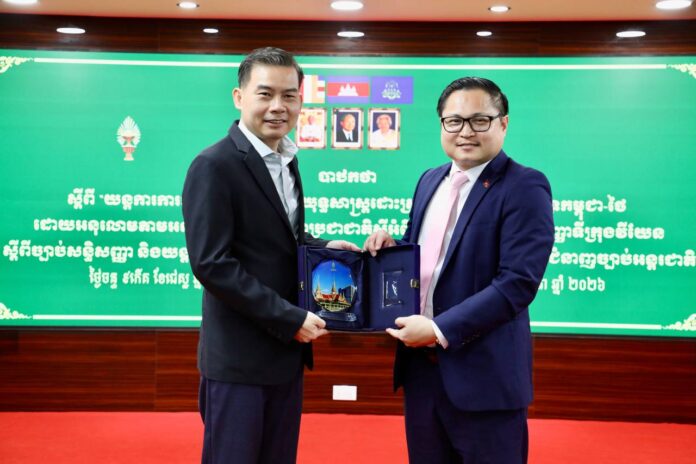
Phnom Penh: Lecture program at the National Assembly Palace, in my capacity as an international law specialist and to share international legal mechanisms in the face of challenges to national sovereignty, under the spirit of the Constitution of the Kingdom of Cambodia, in accordance with the new Article 51, on behalf of the Cambodian people who are the owners of the destiny of their nation.

Strengthening Cambodia’s Strategic Commitment: Using UNCLOS Law of the Sea Mechanisms and Taking the Lead in Diplomatic Resolution of the Cambodia-Thailand Sovereignty Dispute

On May 25, 2026, international law expert who received direct training from the United Nations in the Law of the Sea, Mr. Ann Pasty, made an important presentation at the National Assembly of the Kingdom of Cambodia as an international law expert and on behalf of a Cambodian intellectual and in the spirit of the nation for the common benefit of all Cambodians. In this lecture, Mr. An Pasti outlined a strategic roadmap for Cambodia’s diplomatic response to Thailand’s violation of Cambodia’s territorial integrity. The core points of the approach he outlined include: First, the continuation of the proactive mechanism of the United Nations Convention on the Law of the Sea (UNCLOS) through the Compulsory Conciliation mechanism. Second, a more proactive and proactive diplomatic strategy with regional and international partners, and a firm call for Thailand to respect the international order based on the rules of law and the ASEAN Charter. and the United Nations Charter.
Mr. Ann Pasty, as an expert in international law and the law of the sea, suggested that Cambodia should increase its diplomatic measures even more strongly by building alliances with key players in ASEAN, Europe, Asia, etc. and all relevant continents, and using ASEAN mechanisms and the international community to help bear wider witness to the issue of Thailand’s continued invasion of Cambodia, for example, Thailand has been continuously invading Cambodia for the past 800 years, and to increase proactive diplomatic mechanisms to obtain collective support from the international community in the sense and spirit of jointly promoting the international order based on rules and jointly opposing acts of aggression that violate international law. By insisting on respecting the ASEAN Charter and the UN Charter, Cambodia, including the international community, can continue to pressure Thailand to resolve the national sovereignty dispute with Cambodia peacefully and as a good neighbor, in true faith and without further manipulation or manipulation. We must come to the JBC mechanism to take a final measure and ask Thailand to stop using excuses to prolong and buy time.
Within this strategic framework, the aim is not only to protect Cambodia’s sovereignty, but also to strengthen the integrity of the implementation of international law by both Cambodian and Thai sides, in the spirit of adhering to the principles of a regional order based on rules and a rules-based international order, and to set a model for the successful peaceful resolution of disputes under the mechanisms of international law and a rules-based international order that originated in our Cambodia.