
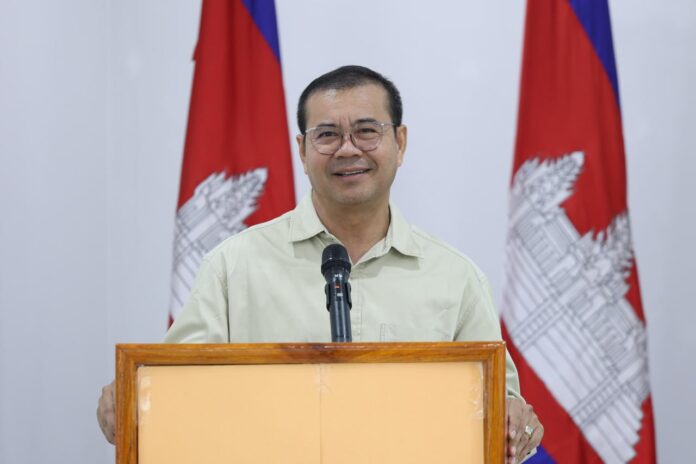
Kampot: Dr. Kao Thach, the Royal Government Delegate in Charge of the Agricultural and Rural Development Bank (ARDB) and President of the Techo Farmers Network Association, on June 10, 2026, reminded farmers in Bokor town, Kampot province that farmers can consider organizing into production groups and changing their farming habits from a family to a clear career to get more profits.

This was stated by Dr. Kao Thach during a meeting with approximately 200 farmers in Bokor town, Kampot province. The ceremony was attended by Mr. Chan Tha, Deputy Governor of Kampot Province, Mr. Sin Pech, Governor of Kampot City, and Ms. Mak Chenda, Deputy Governor of Bokor City, district administration officials and officials from the municipal Agriculture, Natural Resources and Environment Office, Sangkat Chiefs, and commune agricultural officials.

On the occasion, Dr. Kao Thach stated that our farmers’ farming often faces many difficulties. The main problems are the production but no market for sale, the problem of high-priced agricultural chemical fertilizers, technical problems, and other capital problems with high interest rates. However, the key to solving this issue for our farmers is to change their farming habits to a new way. Do not farm just to feed the rice cooker, but use modern techniques to produce local natural fertilizers instead, which will completely reduce costs and make profits.

At this point, Dr. Thamkang suggested that farmers from the communes in Kampot and Bokor should consider forming groups to do farming and think clearly about modern farming to become a profession and make more profits, especially knowing how to consider the cost of production per unit, whether for rice, vegetables, or animal husbandry.

Finally, to address the above challenges, Dr. Ban called on farmers to join the Techo Farmers Network Association, which was established to serve farmers. The association will serve as: (1) a bridge to find financial sources, access to new techniques and information, relay the voices and concerns of farmers to leaders, and be a bridge to other opportunities; and (2) an umbrella or shield for farmers, that is, to protect the legitimacy or legality of farmers or protect them from abuses and profits against farmers.
->