
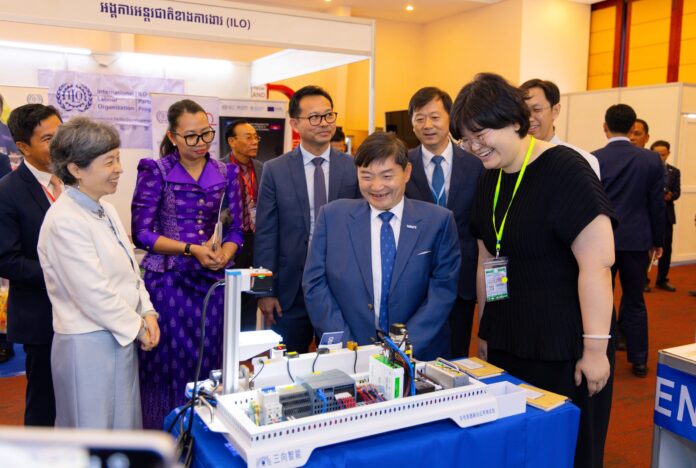
Phnom Penh: On the afternoon of June 16, 2026, Mr. Heng Sour, Minister of Labor and Vocational Training, presided over the official closing ceremony of the “9th National Technical and Vocational Education and Training Day 2026” held under the theme “TVET provides skills, jobs and income” at the Koh Pich Convention and Exhibition Center, with the participation of representatives of ministries and institutions, national and international development partners, including the Asian Development Bank (ADB), the World Bank (WB), the French Development Agency (AFD), the United Nations (UN), the International Labor Organization (ILO), the Swiss Agency for Development and Cooperation (SDC), the Korea International Cooperation Agency (KOICA), and a total of more than 1,000 stakeholders.

According to a report by Mr. Hing Sidet, Director General of the General Department of Technical and Vocational Education and Training, the success of this year’s National Day was demonstrated by nearly 100,000 participants across the country. What is a matter of national pride is that Cambodian TVET students have demonstrated their high ability to create modern robots and have already participated in advanced production chains.

Speaking on this occasion, Minister Heng Sour stated that in line with the noble words of His Majesty the King, Hun Sen Prime Minister of the Kingdom of Cambodia, TVET is not a second-level education or lower than a bachelor’s degree, but TVET skills are the right, honest and valuable skills that the job market both domestically and internationally needs the most, as the Ministry is promoting new developments to make the TVET sector a training center or a place to teach how to fish and truly know the lake.

In response to the Prime Minister’s directive to focus on quality first and avoid learning by rote, the Minister made a strong commitment to leading the reform and implementing key strategic directions, including for TVET institutions to continue to revolutionize training by integrating digital technology, artificial intelligence (AI) and automation systems, as well as specialize in skills based on local potential, promote the “bringing skills to learners” strategy, and provide free training and recognition of prior learning (RPL) assessments to Cambodian workers returning from Thailand.

Meanwhile, the General Department of TVET must cooperate with the Ministry of Education, Youth and Sports to successfully implement the “vocational path” from the 2025-2026 academic year onwards, as well as continue to compile a Cambodian skills pool and promote the training of young people from poor and vulnerable families to achieve a total of 1.5 million, based primarily on quality. For the private sector, the Minister suggested continuing to play an indispensable strategic partner through the Public-Private Partnership (PPP) mechanism by increasing opportunities for internships and apprenticeships to link training to actual production chains.


Meanwhile, Xiaoyan Qian, Director of the International Labour Organization (ILO) in Cambodia, Laos and Thailand, also emphasized that TVET skills are not just a common benefit, but an important “national strategic asset” in building Cambodia’s future. By creating decent jobs and sustainable incomes. She highly appreciated the Royal Government’s commitment to modernizing the skills system and stressed the importance of RPL testing, especially for returning migrant workers, and called for a joint effort to turn dialogue into action by strengthening public-private partnerships to ensure quality, timely and responsive skills development for the digital job market, leaving no one behind.

On this occasion, the Minister also presented certificates of appreciation and letters of gratitude to business owners, educational institutions, and development partners in building human capital to lead Cambodia towards the vision of becoming a high-income country by 2050.