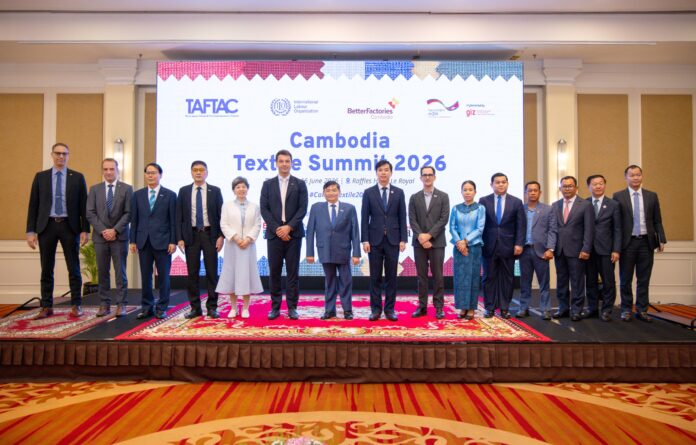
Phnom Penh: Presiding over the opening ceremony of the Cambodian Textile Summit 2026 on the morning of June 16 at Raffles Hotel Le Royal, Mr. Heng Sour, Minister of Labor and Vocational Training, highlighted that the textile, garment, footwear, and travel and bag sectors are the most important pillars of Cambodia’s economic growth, directly employing more than 1.2 million workers, even during the global crisis.

In front of more than 200 participants representing government institutions, employer associations, global brands, development partners and unions, the Minister said that the gathering demonstrates a shared commitment to promoting sustainability, innovation and resilience of this most important economic sector of the sector. As the garment, textile and footwear (GFT) industry faces a global crisis that is affecting export profits, the meeting is crucial to discuss and review policies, regulatory frameworks and operational strategies that will help strengthen Cambodia’s position in the global garment supply chain.
Cambodia remains committed to promoting workers’ rights, safety and security Strengthen the competitiveness and sustainability of the textile sector.

He said the sector remains the largest source of income, contributing approximately 50% of total export value, and continues to show strong and sustainable growth, while the number of enterprises in the GFT and supporting sectors registered with the ministry continues to increase. As of May 2026, there were approximately 2,000 active enterprises employing approximately 1.2 million workers. The garment sector still maintains the largest share in both the number of factories and jobs, with 1,468 enterprises, 275 travel and bag factories, and 231 footwear factories.

Cambodia has become a source of responsible and highly competitive manufacturing, based on industrial harmonization, a strong legal framework, and internationally recognized labor standards. Ratification of 8 out of 10 core ILO conventions and support from the Better Factories Cambodia (BFC) program provides investors with a transparent, ethical business environment and gains the trust of the international community. Therefore, Cambodia is committed to continuing to expand the BFC program and implement fair labor, effective dispute resolution mechanisms, and social protection to ensure inclusive and sustainable economic growth.

The Minister said that Cambodia continues to combat forced labor, child labor, violence, and harassment in the workplace. And is also taking proactive measures to respond to new challenges, such as heat stress due to climate change. As it prepares to graduate from Least Developed Country status by 2029, Cambodia is turning challenges into opportunities by diversifying its economy, integrating trade, developing infrastructure, and investing in skills development, especially 1.5 million TVET programs that provide a young workforce with advanced technical skills.

Minister encourages brand owners, buyers and all stakeholders to further strengthen partnerships with Cambodia by supporting workplace safety, responsible business practices, skills development, and improving transport safety for workers to build a sustainable, resilient, and highly competitive industry that benefits workers, enterprises, investors, and consumers, and contributes to long-term economic and social development.

Representatives from the co-organizers of the meeting, including the ILO, TAFTAC and GIZ, expressed their strong hope that the meeting would provide knowledge and fruitful discussions to address all challenges in the sector.